
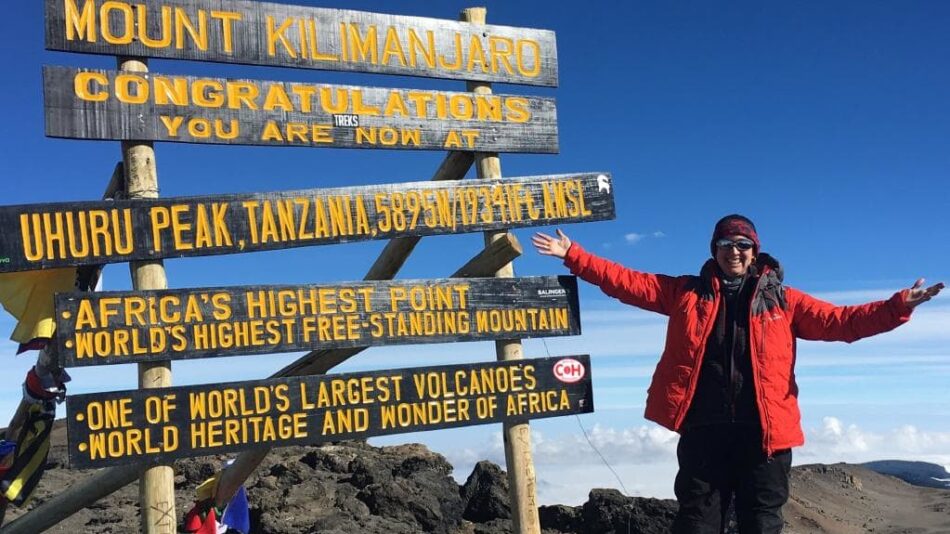
6 Days Rongai Route Kilimanjaro Climb
Request a quote View →
PPF Olorien Business Centre, Njiro, Arusha +255 765 772 906 WhatsApp info@encloseafricasafaris.com
5.0/5 on Tripadvisor and Google Licensed Tanzania Tour Operator
Tanzania
Marangu is the classic route up Kilimanjaro and the only one where every night on the mountain is spent in a hut. Mandara, Horombo, and Kibo Huts provide bunks, mattresses, and communal dining rooms, which spares you tent life and earned Marangu its long-standing nickname, the Coca-Cola route. The gradient is the gentlest of the established routes, and you ascend and descend on the same well-worn trail, so the walking is as predictable as a Climb Mount Kilimanjaro itinerary gets.
What makes this 6-day version worth choosing over the 5-day Marangu climb is the dedicated acclimatization day at Horombo Hut. You hike high toward Kibo Hut, gaining up to roughly 780 m, then sleep back down at 3,720 m. That climb-high, sleep-low day is the simplest lever available for raising summit success on a route that otherwise ascends quickly, and it makes this itinerary the better pick for first-time high-altitude trekkers.
The package covers the whole journey, not just the trek: pickup at Kilimanjaro International Airport, a hotel night in Moshi, Tanzania with a briefing from your guide the evening before the climb, full guide, cook, and porter support on the mountain, and a recovery night at your Moshi hotel after you come down.
In the morning your guide and support crew pick you up from your hotel and drive to Marangu Gate, the eastern entrance to Kilimanjaro National Park. After registration and permit formalities, the trek begins on a wide forest trail through lush montane rainforest, with your guide sharing the mountain's history and pointing out birds and other wildlife along the way. The altitude routine starts immediately: abstain from alcohol and caffeine, drink more than 4 liters of water each day, and consider Diamox for altitude sickness after consulting your doctor. You reach Mandara Hut in time to settle in before dinner. Elevation: 1,860 m to 2,700 m. Distance: 11 km. Hiking time: 5 to 7 hours.
After an early breakfast the trail climbs out of the forest and into open heath and moorland. The reward for the gain in altitude is the scenery: the snowcapped summit of Kibo and the spiky ridgeline of Mawenzi both appear on clear days, and the trail passes giant groundsels, lobelias, and other plants found only at these elevations. You break for lunch on the trail and reach Horombo Hut in the afternoon. Before dinner there is an easy acclimatization hike, a short walk up the trail toward Kibo Hut and back that speeds up your body's adjustment and raises your summit chances. Elevation: 2,700 m to 3,720 m. Distance: 10 km. Hiking time: 5 to 6 hours. Acclimatization hike: 3,720 m to 3,920 m, 2.5 km, 1 to 2 hours.
This is the day that separates the 6-day Marangu itinerary from the 5-day version, and it is the single biggest boost to your summit odds. After breakfast you hike up the trail toward Kibo Hut, gaining significant altitude, then return to Horombo Hut to sleep low. The climb-high, sleep-low pattern pushes your body to adapt without the strain of carrying on upward. After lunch the afternoon is yours: walk the surrounding moorland, photograph Mawenzi Volcano, or simply rest and hydrate for the days ahead. Acclimatization hike: 3,720 m to 4,500 m. Distance: 5 to 8 km. Hiking time: 3 to 4 hours.
After breakfast you cross the Saddle, the high alpine desert between Mawenzi and Kibo. The walking itself is not especially difficult, but the altitude is real, so the crew keeps the pace deliberately slow to preserve your strength for summit night. Lunch is served on arrival at Kibo Hut, which sits at the foot of the final summit cone. The rest of the day is about doing as little as possible: avoid strenuous activity, drink plenty of water, prepare your summit kit, and sleep as much as you can before the pre-midnight start. Elevation: 3,720 m to 4,700 m. Distance: 10 km. Hiking time: 4 to 8 hours.
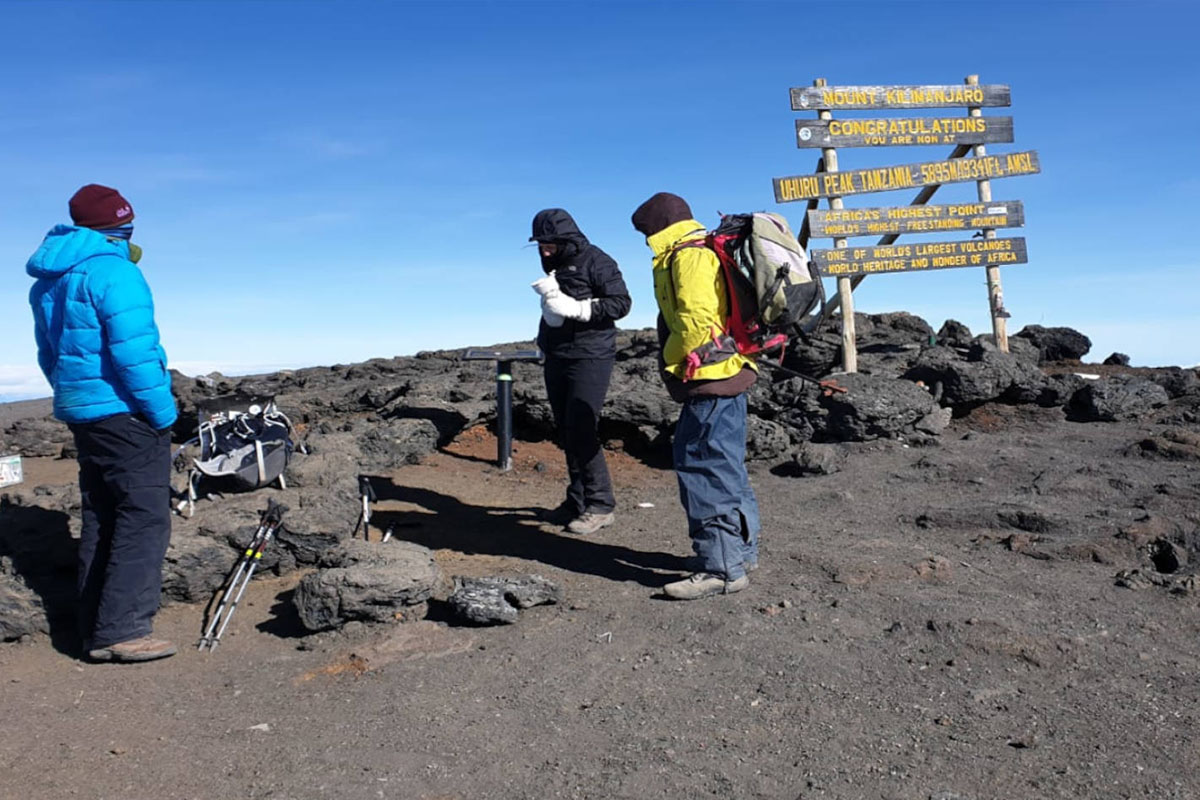
You leave Kibo Hut in the middle of the night and climb by headlamp toward the crater rim. The terrain is physically moderate, but the altitude makes this the hardest day of the trip, which is why each pair of climbers has a dedicated guide monitoring stamina and resolve throughout the ascent. Uhuru Peak, at 5,895 m, is the roof of Africa, and if energy allows you can take a short walk down to the nearest glacier before turning around. Back at Kibo Hut you rest for about two hours, then continue down to Horombo Hut. Take the descent seriously: tired legs on loose scree are how most injuries happen, so watch your footing and protect your toes on the long downhill. Elevation: 4,700 m to 5,895 m to 3,720 m. Distance: 16 km. Hiking time: 9 to 12 hours.
A warm breakfast starts the final morning, then the trail drops steadily back through moorland and rainforest to Marangu Gate at the park exit. The whole team gathers at the bottom to congratulate you, and there is time to add your impressions to the guestbook before commemorative certificates are handed out at the park office. Your driver then takes you back to your hotel in Moshi to clean up and celebrate. Elevation: 3,720 m to 1,860 m. Distance: 18 km. Hiking time: 5 to 6 hours.
Uhuru Peak is 5,895 m. Almost everyone feels the altitude, and acute mountain sickness is common on Kilimanjaro, including on well-paced routes. Acclimatization varies from person to person and is never something you finish; a longer route improves your odds, it does not remove the risk.
Tell your guide about every symptom. Headache, nausea, dizziness, breathlessness at rest, loss of coordination, or confusion all matter, and they matter more at night. Guides carry a pulse oximeter and check you daily.
Descent is the treatment. If symptoms worsen, going down is not a failed summit attempt, it is the correct response, and your guide's call to descend is final. Every climb is escorted by guides trained to make that decision.
See a travel clinician before you book, especially about acetazolamide and any existing heart or lung condition. Nothing on this page is medical advice. For current guidance, read the US CDC on high-altitude travel and altitude illness. Reviewed 24 August 2026.
Read our travel guides to the places this itinerary visits.
Every itinerary is private and fully customizable. Use these as a starting point.
Tell us your dates and what you would love to see. The Enclose Africa Safaris team replies within one business day with your personal itinerary proposal, no obligation.